Golden Plains Shire · Wadawurrung Country
Smythesdale, from the record
Smythe’s run and the gold, the government camp and the borough, the bank manager’s murder and the gallows behind the stables, the railway, and the court house the Historical Society keeps. With a plan of where it happened.
Fig. 1
The history
From the public record: the newspapers on Trove, the heritage listings, the State Library’s photographs. Where the sources disagree, the page says so. The year beside each part is the year it turns on. The Woady Yaloak Historical Society, in the court house, has the district’s own records, and J. G. Roberts’s Smythe’s Creek and Smythesdale (1930) is the real history; this page has not read it.
Before 1849
Wadawurrung Country
Smythesdale is on Wadawurrung Country. In the Wadawurrung Traditional Owners Aboriginal Corporation’s own words: “We acknowledge that our Ancestors nurtured and cared for Wadawurrung Country for tens of thousands of years.”
No Wadawurrung name for the place, the creek or the Woady Yaloak was found in anything the Corporation has published. Anything more is theirs to say.
1849
Smythe’s run
The name is John Smythe’s, who took up a pastoral lease here in 1849. His name and his run’s, Nentinball, are on the map closer to Ballarat, at Smythes Creek, and the creek runs on through the town.
From Victorian Places, Smythesdale and the Victorian Heritage Database, Smythesdale Primary School.
1853
Gold on Smythe’s Creek
A Geelong party under H. Swindells found gold on the Woady Yaloak in 1852. In the autumn of 1853 more than a thousand diggers rushed Smythe’s Creek and left again, “the attempt to work them beneficially, a failure”. A few stayed on, and in October one party washed out 46 ounces in three days. By the end of the month 800 diggers were on the creek, the gold “large and very much waterworn”, and the luckiest were clearing £300 a week.
Swindells claimed a reward for his find in 1864, and got £100.
Fig. 2
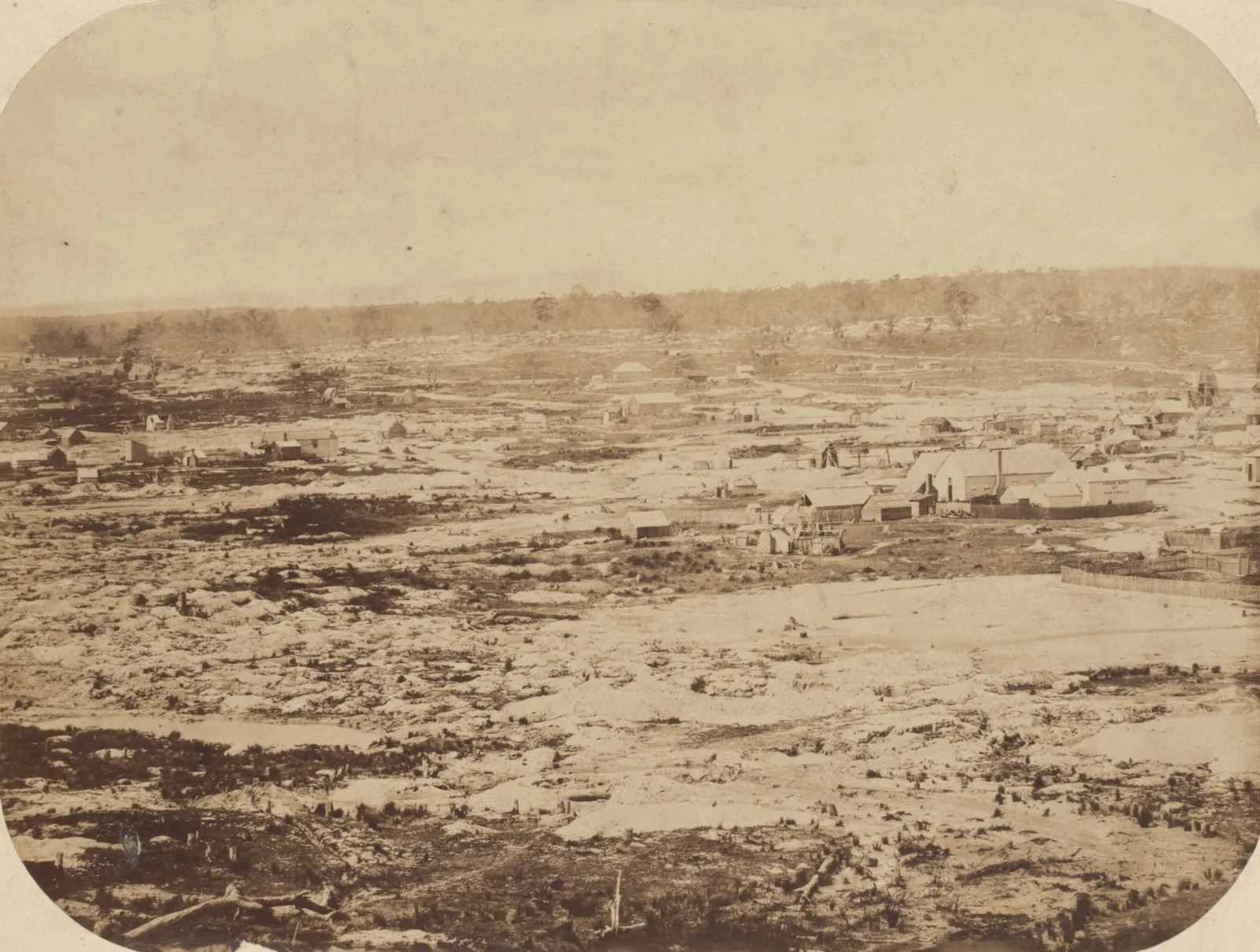
Smythesdale in 1861, across the diggings. Solomon & Bardwell. State Library Victoria, H26084 From the Kalgoorlie Miner, 13 September 1930, the Freeman’s Journal, 7 May 1853, the Geelong Advertiser, 1 October 1853 and the Geelong Advertiser, 31 October 1853.
1859
A township called Smythesdale
The diggers at Warren’s Lead wanted a township, and Peter Lalor, their member, took their case to the Lands Office himself. “Smythe’s Creek was proclaimed a township on the 20th April, 1859”, as Smythesdale, and two balls were planned to celebrate. The old name stayed in use for years: there was a “Bank of Australasia, Smythe’s Creek” in 1860, and the post office kept it until 1864.
In October David La Motty opened the Court House Hotel, “Opposite the Camp, Smythesdale… in a style not to be surpassed by any in the colony”.
On the plan: 2, The Court House Hotel.
Fig. 3
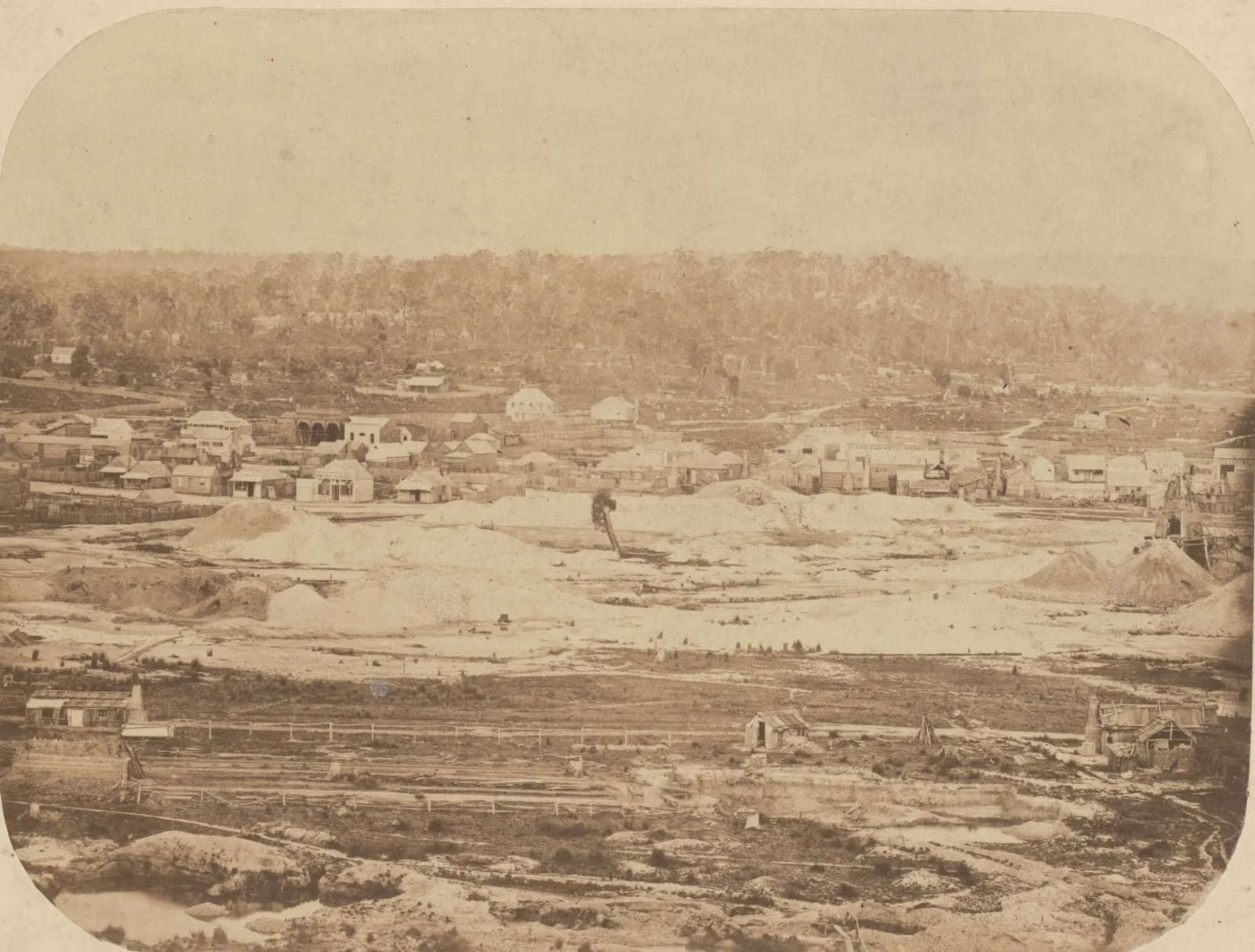
The township two years after it was proclaimed, 1861: Brooke Street on the far side, with the El Dorado Hotel. Solomon & Bardwell. State Library Victoria, H2033 From the Star, 18 April 1859, the Star, 22 April 1859, the Star, 6 August 1860, Victorian Places, Smythesdale and the Star, 8 October 1859.
1860
The camp
In May 1859 the court house at Black Hill was moved to the Government reserve at Warren’s Lead, where the camp stood, and in June the Public Works Office called tenders for police buildings. The stables, of rendered brick, are from that year, with stalls for the four horses of the mounted police; they are the only such stables known to survive in Victoria. The brick court house was built in 1860 by Bond and Company for £911, and sat as a court of petty sessions, of mines and of the county. (The Historical Society’s page says 1861.)
The bluestone lock-up replaced a portable one, in 1866, 1867 or 1869: the records give all three. J. P. Hamilton came as police magistrate in 1859; his house is gone, but the oaks, cypresses and cedars of its garden are still there. The stables and the lock-up served until 1959.
On the plan: 1, The camp; 3, The magistrate’s garden.
Fig. 4
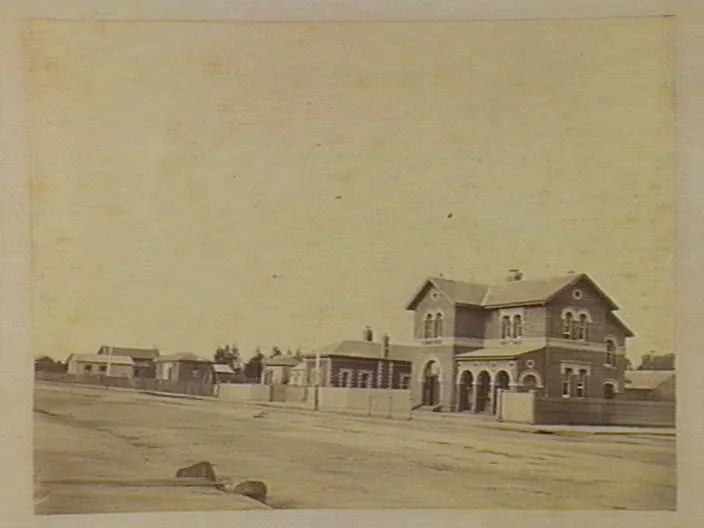
The Post Office and Government Buildings, 1866. The Library serves only this small copy. State Library Victoria, H1690 From the Star, 6 May 1859, the Star, 3 June 1859, the Victorian Heritage Database, Smythesdale police buildings, the Victorian Heritage Register, Smythesdale Court House (H1653), the Register of the National Estate, Smythesdale Court House, the National Trust’s record of the Smythesdale lock-up, the Historical Society’s precinct signs, as Aussie Towns transcribes them and the Victorian Heritage Database, the Police Magistrate’s garden.
1861
The borough
The borough was proclaimed on 12 April 1861, a square of about 2.4 kilometres crossing the creek, and 1,794 people lived in the township at that year’s census. In May the new council came to meet in the court house and found the door locked against it. They adjourned to Campbell’s Assembly room, where Councillors Saenger, Crossen and Lynch “delivered themselves strongly on the indignity shown them by Mr Hamilton, police magistrate”.
John Lynch had been one of Peter Lalor’s captains at Eureka. His son Arthur was born at Smythesdale that October, grew up a runner in a town known for athletics, fought for the Boers, and was sentenced in London in 1903 to be hanged for treason; he was pardoned and sat in the House of Commons. Seven of the Lynches’ fourteen children died within eight months of each other, five of them in the diphtheria of 1872. Hamilton’s daughter Lillias, born here in 1867, became Lillias Skene, a leader in the women’s movement.
Fig. 5
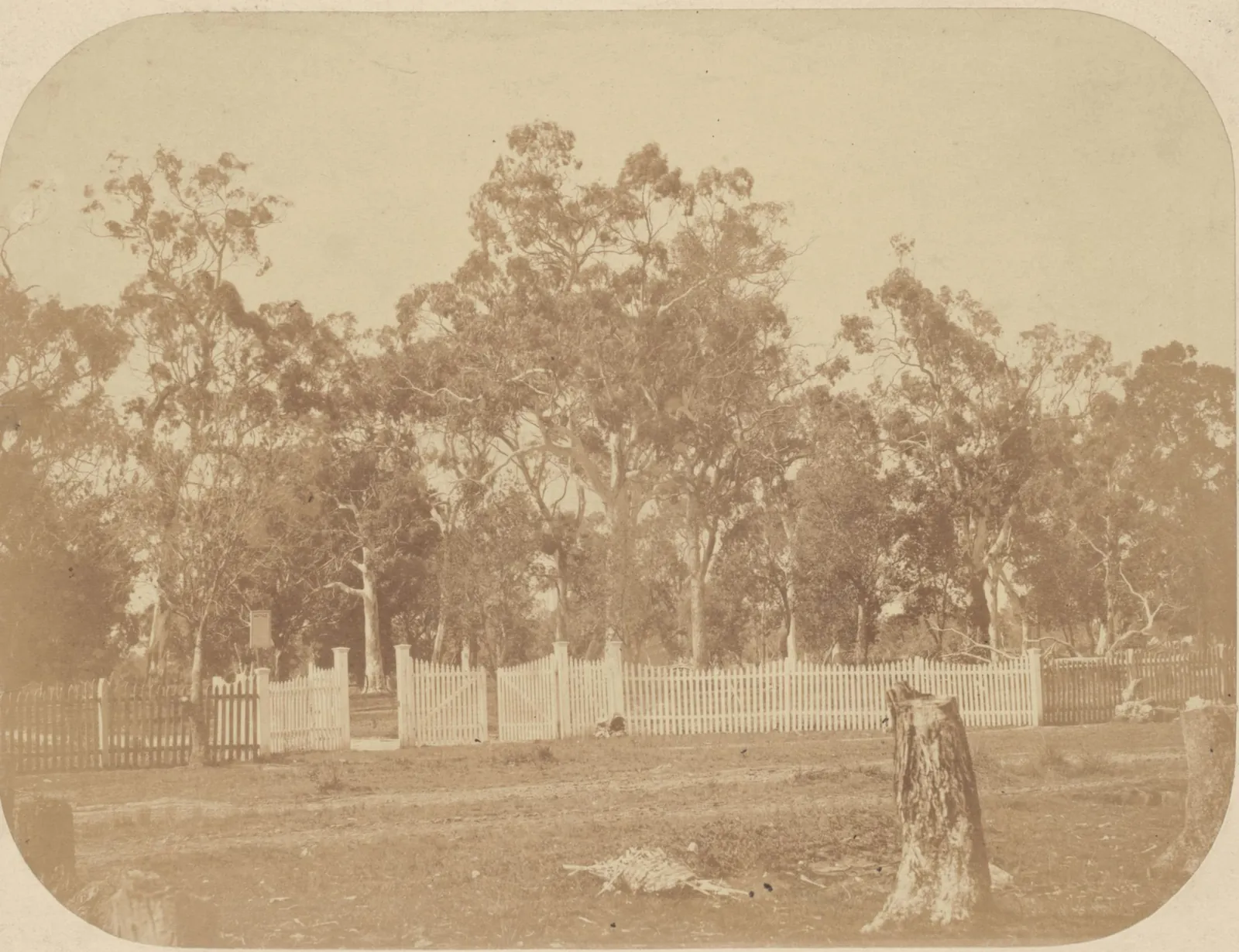
The cemetery in 1861, two years after its first burial. Solomon & Bardwell. State Library Victoria, H2023 From the Star, 15 April 1861, Victorian Places, Smythesdale, the Star, 13 May 1861, the Australian Dictionary of Biography, Arthur Alfred Lynch, the Smythesdale Cemetery Trust’s own history and the Australian Dictionary of Biography, Lillias Skene.
1863
The boiler and the brigade
When bushfire burnt Robert McGie’s saw-mill at Ross’s Creek, he moved its engine and boiler to a piece of ground behind the township. On Saturday 14 March 1863 the boiler blew up and was thrown nearly 200 yards. A carpenter on a ladder was killed outright, a bullock driver died within hours, and McGie’s nephew, scalded all over, died that night. The inquest heard that a boy of eight had been regulating the engine.
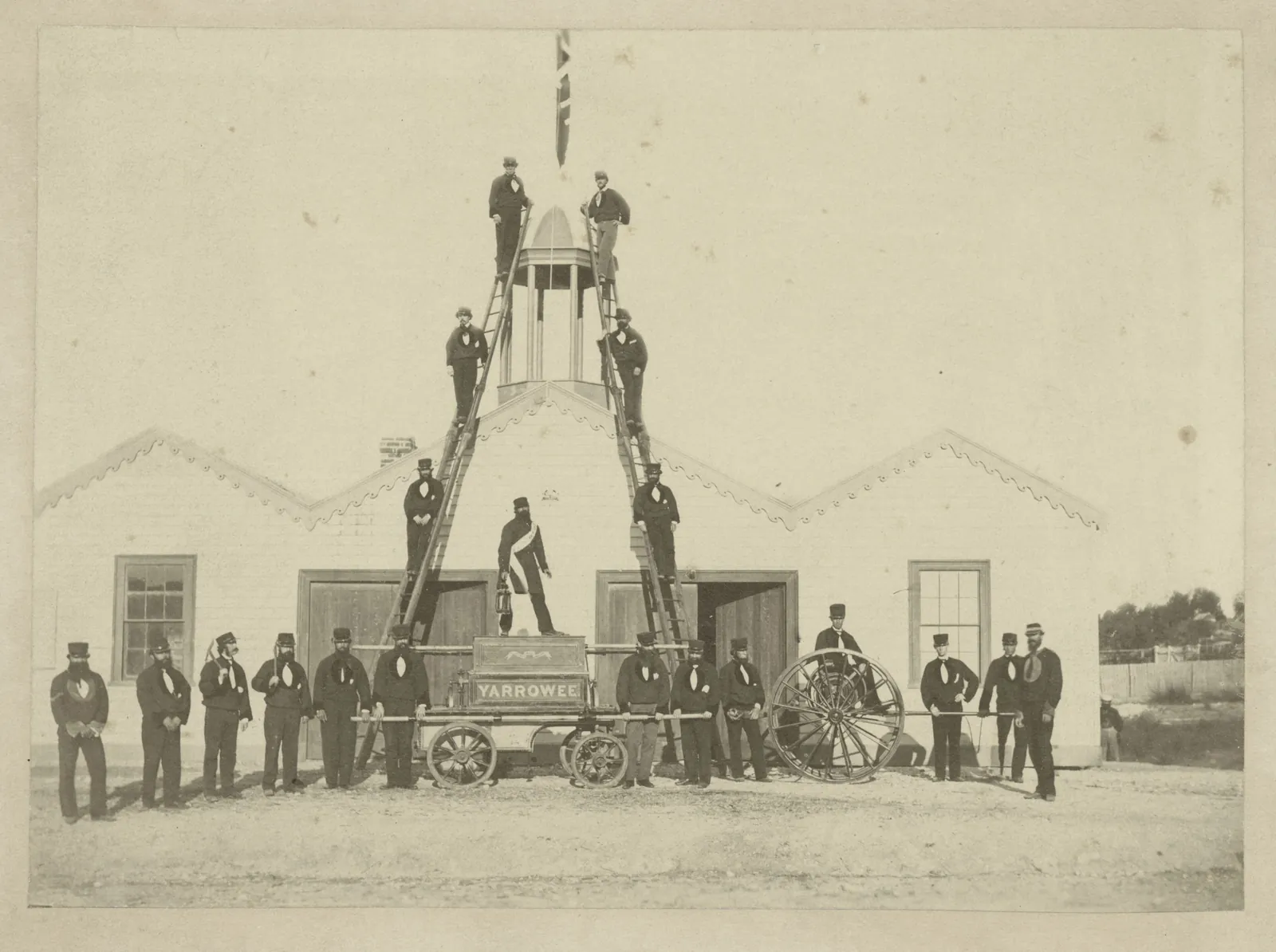
The Smythesdale Fire Brigade drilled for the first time that February, and bought Ballarat West’s engine, the Yarrowee. It kept its fiftieth anniversary in 1913 with one of its first members there. On 5 January 1896 it went out “with engine and reel” to a bushfire from Argyle Gully, where the flames stood thirty feet high in the scrub, and saved Mrs Walsh’s house.
From the Herald, 17 March 1863, the Star, 18 February 1863, the Ballarat Star, 13 October 1913 and the Ballarat Star, 6 January 1896.
1864
The Chinese miners
In May 1859 Chinese miners were puddling up the creek “with prosperous results”, and a ten-ounce nugget of crystallised gold “found by some Chinamen at Smythesdale” went on show in Ballarat. By 1864 the old shallow ground at the head of the creek had been “given over to the quiet possession for the most part of our Chinese fellow-colonists”, fossicking in the old holes.
In 1867 there was a Smythesdale Chinese camp, with a store and butchery, and a joss-house. Where they stood is not recorded. The Historical Society’s tableau outside the police station shows Officer Armstrong arresting Ah Woa, a forty-year-old miner, for having no residence ticket, on 14 October 1859, his European wife following with their baby; that arrest rests on the Society’s sign. The cemetery has a Chinese section.
From the Star, 6 May 1859, the Star, 2 May 1859, the Geelong Advertiser, 30 December 1864, the Ballarat Star, 11 February 1867, the Historical Society’s precinct signs, as Aussie Towns transcribes them and the Victorian Heritage Database, Smythesdale General Cemetery.
1866
The town at its height
In the 1860s Smythesdale had a mechanics’ institute and free library, a foundry, a saw-mill, a brewery, a racecourse, a theatrical club and hotels in numbers. In 1865 the mayor saw a pair of English skylarks in the borough’s botanic garden, and in 1866 Ferdinand von Mueller sent English oaks, ash and willows for it. The gardens were the sports ground too, and in 1882 the mayor fought off the railway’s plan to take part of them.
In 1866 the shire had James Overend, a local mason, cut stone mileposts for the road from Pittong to Sebastopol; one reads “Ballarat 12 – Smythesdale 0 – Scarsdale 3 – Linton 9”. In 1942 most were buried, so an invading army could not read them, and they were put back after the war. By 1902 the licensing division had six hotels, five of them held by women.
On the plan: 8, The gardens.
Fig. 6
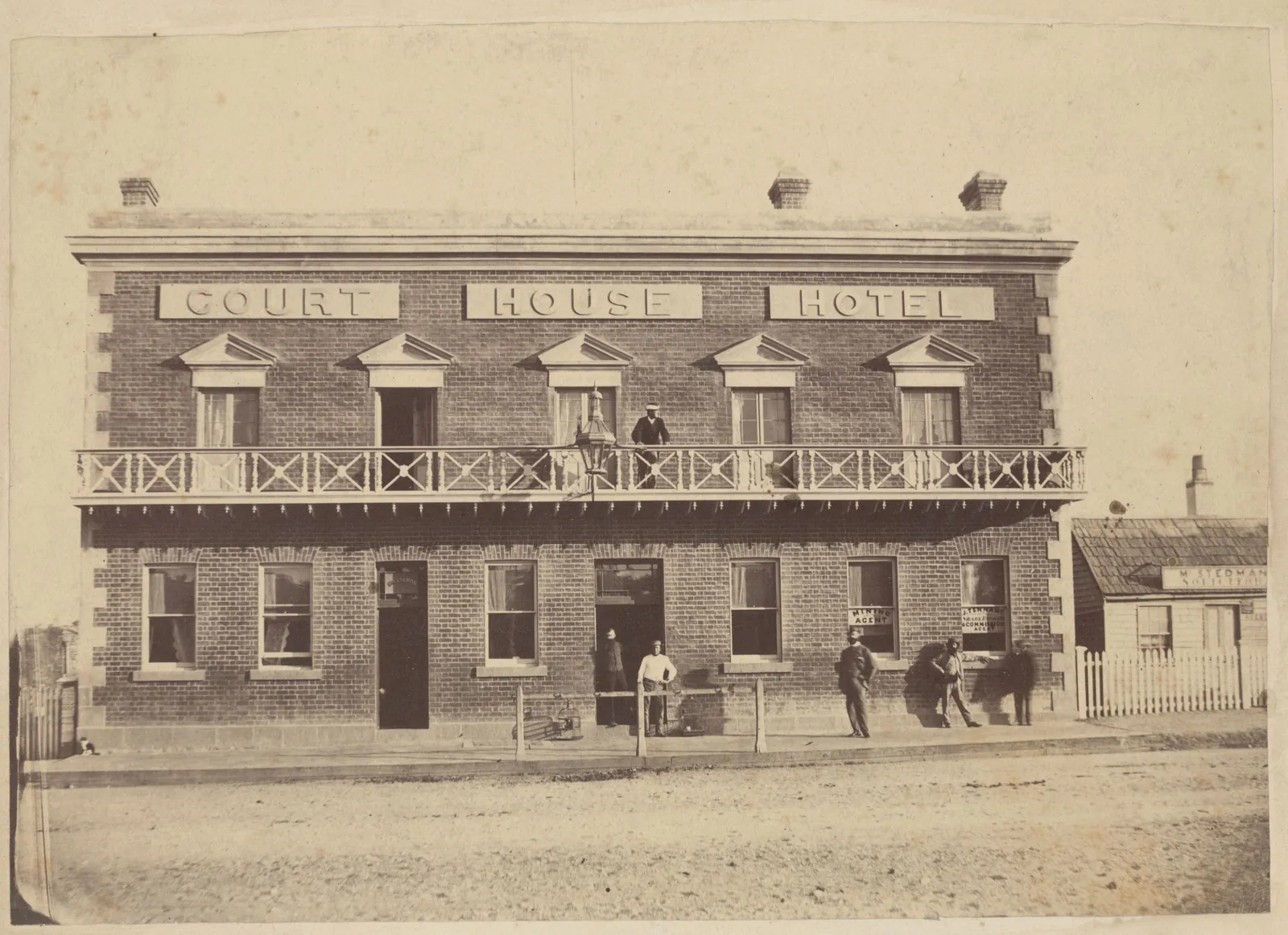
La Motty’s Court House Hotel, 1866, opposite the camp. State Library Victoria, H1681 From Victorian Places, Smythesdale, the Argus, 11 November 1865, the Ballarat Star, 28 June 1866, the Ballarat Star, 22 December 1882, the Victorian Heritage Database, the former Smythesdale Botanic Gardens, the Victorian Heritage Register, the Glenelg Highway mileposts (H1701) and the Grenville Standard, 13 December 1902.
1867
The bank manager
On Friday 10 May 1867 Thomas Ulick Burke, manager of the Bank of Australasia at Smythesdale, drove out on his fortnightly round to buy the gold at Break o’ Day. His horse came home alone. His wife, “exclaiming… ‘I want to go to look for my husband’”, searched all night with blankets in the buggy. He was found the next afternoon in a gully near Derwent Jack’s, shot in the head, and the gold gone.
George Searle, a publican at Break o’ Day, and Joseph Ballan, a miner, were committed for trial at the Smythesdale court on 19 June, before Hamilton, with “immense crowds” round the court house and eight reporters inside. They were hanged at Ballarat on 7 August. Two other Smythesdale cases went to the same gallows: Alexander Davis in 1864, for killing George Sims in his tent, and James Jones in 1866, for shooting Dr Saenger, the councillor who had tended the boiler’s victims. The Historical Society’s sign says those gallows were obtained when the Ballarat gaol was pulled down in 1965, and they stand behind the police stables. Nobody is recorded as hanged at Smythesdale.
On the plan: 1, The camp.
Fig. 7
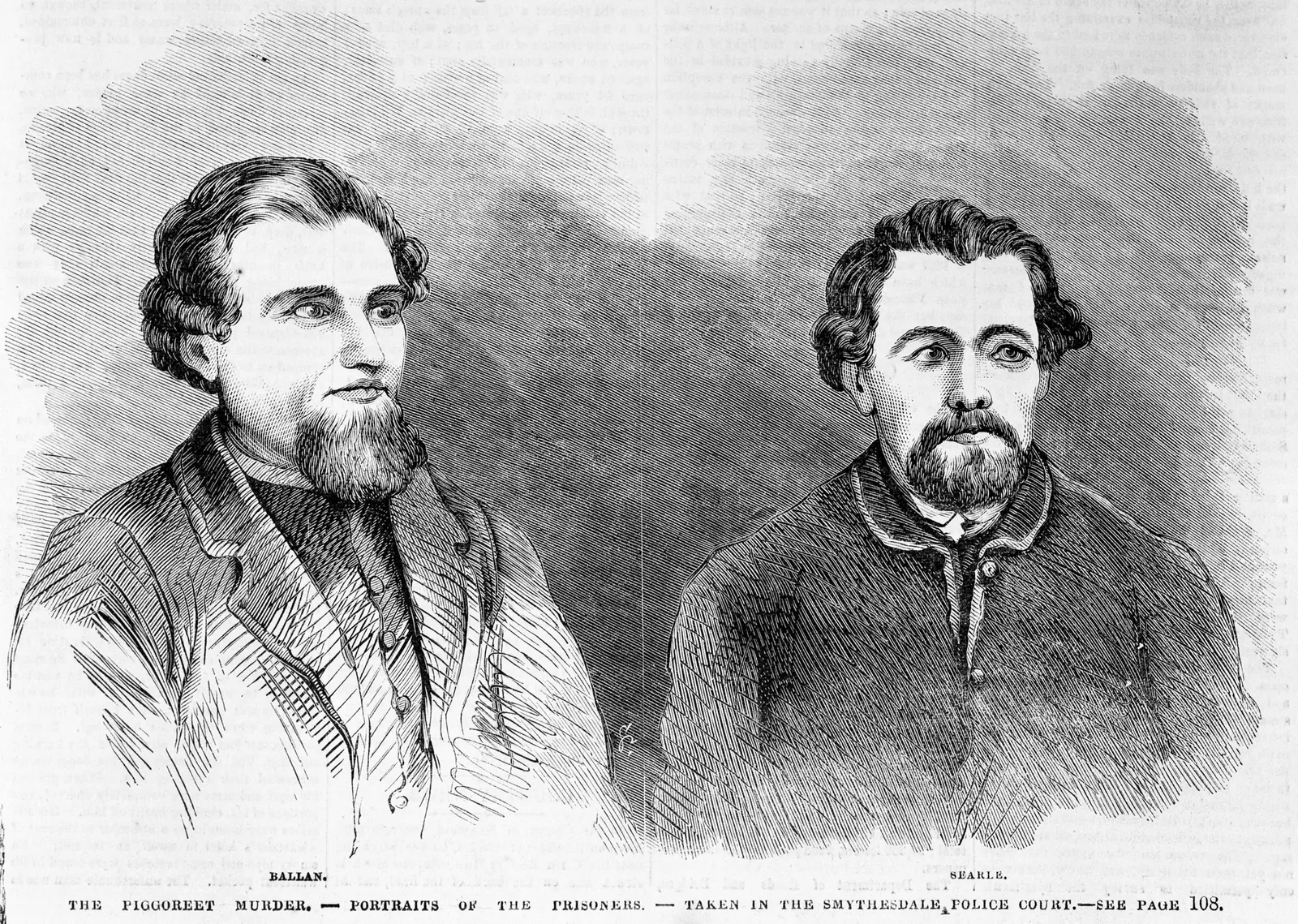
Joseph Ballan and George Searle, “taken in the Smythesdale Police Court”: Samuel Calvert’s engraving for the Illustrated Melbourne Post, 27 July 1867. State Library Victoria, IMP27/07/67/97 From the Ballarat Star, 13 May 1867, the Leader, 22 June 1867, the Ballarat Star, 21 June 1867, the Yass Courier, 14 August 1867, the Geelong Advertiser, 5 June 1863, the Argus, 1 March 1864, the Age, 20 March 1866 and the Historical Society’s gallows sign, as Goldfields Guide transcribes it.
1883
The railway
The line from Ballarat opened for traffic on Wednesday 1 August 1883: thirteen miles, £25,770, and four stations, Trunk Lead, Haddon, Smythesdale and Scarsdale, “much patronised by the wondering and happy residents of the district”. The children of Smythesdale and Scarsdale had hoped the Minister would give them a free trip.
It reached Skipton in 1916, lost its passengers in 1972, and closed in 1983 or 1986 (the sources differ). The station was in Ireland Street, and nothing of it survives. The line is the Ballarat–Skipton Rail Trail.
On the plan: 7, The railway station.
From the Ballarat Star, 2 August 1883, the Argus, 4 August 1883, the Ballarat Courier, 16 July 1883, Victorian Places, Smythesdale and the Victorian Heritage Database, Smythesdale precinct.
1915
The borough’s end
The town shrank with the gold: 1,794 people in 1861, 685 in 1881, 421 in 1891, 275 in 1933. In March 1915 the Minister found that the borough could no longer raise £300 in rates, and on 1 October it was joined to the Shire of Grenville. Gold went on in the ground around it: pumped sluicing until 1915, the Yellow Glen leases in the 1930s.
On the plan: 4, The old post office; 5, The Mechanics’ Institute and the Union Bank.
Fig. 8
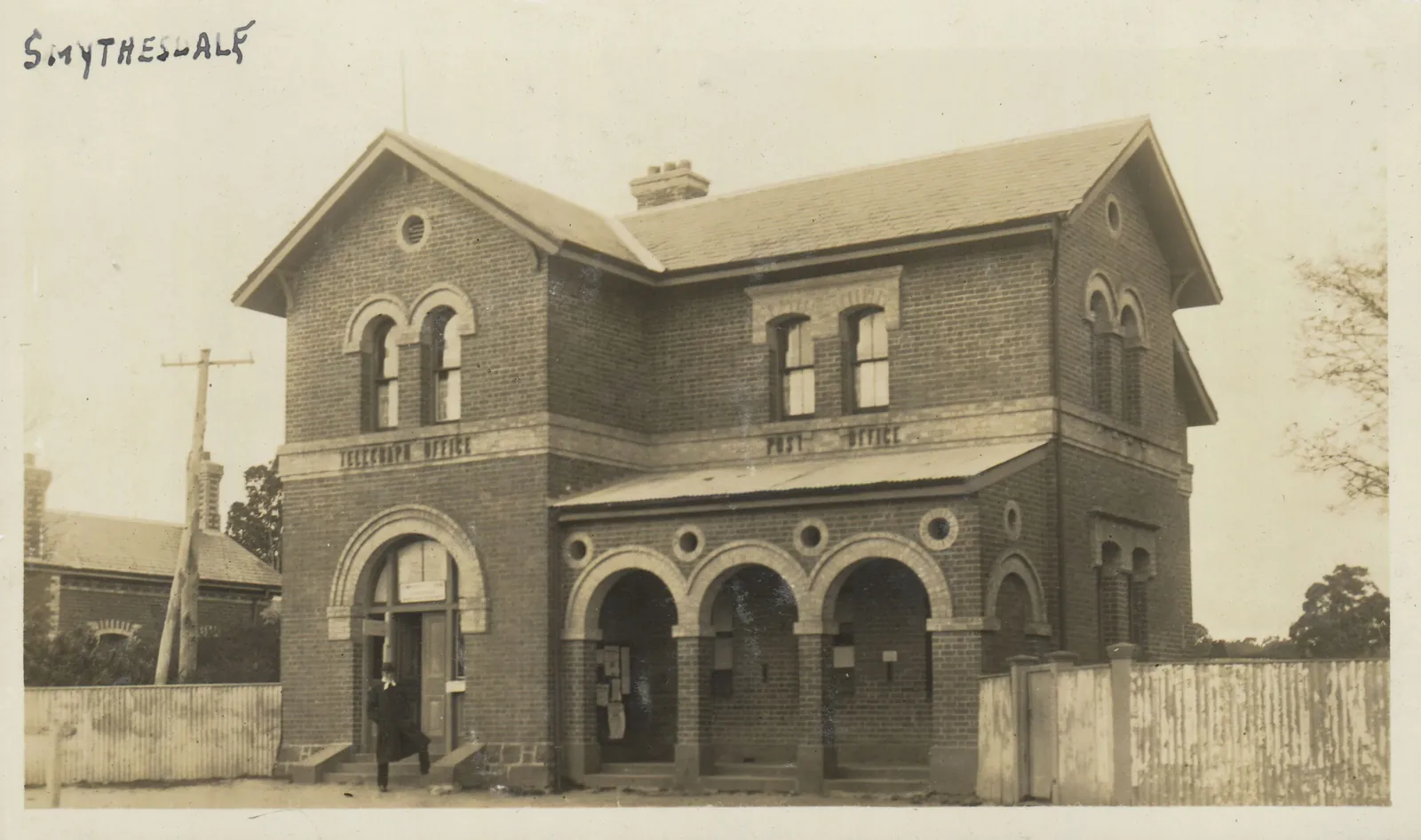
The post office on Brooke Street, between 1917 and 1930. It was a post office until 1974. State Library Victoria, H89.105/214 From Victorian Places, Smythesdale, the Grenville Standard, 6 March 1915, the Grenville Standard, 2 October 1915 and the Heritage Inventory, Boyd’s Hydraulic Sluicing Company.
1918
The avenue
On Saturday 10 August 1918 the town planted a hundred trees towards an avenue of honour, from the north past the fire station into the main street. The first was put in by four returned soldiers, Privates Dennis, Veal, Green and Abbott; the second, for the Anzacs, by Mrs T. Dickson, whose son was one of the first to enlist from Smythesdale. The other ninety-seven were planted by soldiers’ families and friends. Harry Walmsley, “a bank clerk from Smythesdale”, was photographed in his uniform in 1915.
On the plan: 9, The avenue.
From the Grenville Standard, 17 August 1918, the Ballarat Star, 12 August 1918 and the Australian War Memorial, DA13231.
1983
The court closes
A magistrate last sat in Smythesdale in 1976, and the court closed on 1 January 1983. A Sunday school had used it; somebody wanted to make it a restaurant. The Government’s files on it ran “from the eradication of bats from the Smythesdale Courthouse to major cracking in building walls”. In April 1985 the Woady Yaloak Historical Society was given the use of it rent free, and has kept it, and the precinct, since. The lock-up was signed over to its care in 2010.
On the plan: 1, The camp.
From the Auditor-General of Victoria, Court Closures in Victoria (1986), the National Trust’s record of the Smythesdale lock-up and the Woady Yaloak Historical Society.
2021
Smythesdale now
In 1971 vines went in on twelve acres at the old Yellow Glen mine, and the wine took its name. The Yellowglen plant at Smythesdale closed in 2006. The town that had 162 people in 1966 had 1,189 in the locality at the 2021 Census.
From Yellowglen’s own history, the Courier, on the Yellowglen estate, Victorian Places, Smythesdale and ABS 2021 Census QuickStats, Smythesdale.
Where it happened
Smythesdale as it lies now, from OpenStreetMap, with the buildings in grey and the rail trail where the railway ran. The court house, the stables, the lock-up and the gallows stand within thirty metres of each other, so they share a pin. Off the plan: the cemetery, 2.6 km south-west; the Surface Hill sluicing pit, 1.9 km east; Yellow Glen, 1.8 km north. Warren’s Lead, the Chinese camp and its joss-house, and McGie’s mill cannot be placed.
1. The camp. The court house of 1860, the police stables of 1859, the bluestone lock-up, and behind the stables the Ballarat Gaol gallows. Now the Historical Society’s.
2. The Court House Hotel. La Motty’s, opened in 1859 “opposite the camp”.
3. The magistrate’s garden. J. P. Hamilton’s oaks, cypresses, cedars and pines. The house is gone; The Well stands in the garden’s corner.
4. The old post office. 50 Brooke Street, a post office until 1974.
5. The Mechanics’ Institute and the Union Bank. 44 and 42 Brooke Street.
6. The school. No. 978, opened in 1871 with 257 pupils. Now a Woady Yaloak campus.
7. The railway station. In Ireland Street, 1883; nothing of it survives. The line is the rail trail now.
8. The gardens. The borough’s botanic garden, where the skylarks were seen in 1865 and Mueller’s oaks were planted.
9. The avenue. The war memorial at the northern entrance, where the avenue of 1918 began. Whether its trees survive is not known.
10. Fraser’s Hill. Sluiced from 1858. The 1866 photographer took his general view of the town from it.
To read more
J. G. Roberts’s Smythe’s Creek and Smythesdale (1930) is the history of the place, and this page has not read it. The Woady Yaloak Historical Society, which keeps the court house, sells it in facsimile from its research room at The Well, 19 Heales Street (Wednesdays), with its own books on the cemetery, the fire brigade, the gallows and Thomas Ulick Burke’s murder.
Sources
Everything above was read on 1 October 2026. Where two sources disagree, the page says so.
- Wadawurrung Traditional Owners Aboriginal Corporation
- Victorian Places, Smythesdale
- The Victorian Heritage Database, Smythesdale Primary School
- The Kalgoorlie Miner, 13 September 1930
- The Freeman’s Journal, 7 May 1853
- The Geelong Advertiser, 1 October 1853
- The Geelong Advertiser, 31 October 1853
- The Star, 18 April 1859
- The Star, 22 April 1859
- The Star, 6 August 1860
- The Star, 8 October 1859
- The Star, 6 May 1859
- The Star, 3 June 1859
- The Victorian Heritage Database, Smythesdale police buildings
- The Victorian Heritage Register, Smythesdale Court House (H1653)
- The Register of the National Estate, Smythesdale Court House
- The National Trust’s record of the Smythesdale lock-up
- The Historical Society’s precinct signs, as Aussie Towns transcribes them
- The Victorian Heritage Database, the Police Magistrate’s garden
- The Star, 15 April 1861
- The Star, 13 May 1861
- The Australian Dictionary of Biography, Arthur Alfred Lynch
- The Smythesdale Cemetery Trust’s own history
- The Australian Dictionary of Biography, Lillias Skene
- The Herald, 17 March 1863
- The Star, 18 February 1863
- The Ballarat Star, 13 October 1913
- The Ballarat Star, 6 January 1896
- The Star, 2 May 1859
- The Geelong Advertiser, 30 December 1864
- The Ballarat Star, 11 February 1867
- The Victorian Heritage Database, Smythesdale General Cemetery
- The Argus, 11 November 1865
- The Ballarat Star, 28 June 1866
- The Ballarat Star, 22 December 1882
- The Victorian Heritage Database, the former Smythesdale Botanic Gardens
- The Victorian Heritage Register, the Glenelg Highway mileposts (H1701)
- The Grenville Standard, 13 December 1902
- The Ballarat Star, 13 May 1867
- The Leader, 22 June 1867
- The Ballarat Star, 21 June 1867
- The Yass Courier, 14 August 1867
- The Geelong Advertiser, 5 June 1863
- The Argus, 1 March 1864
- The Age, 20 March 1866
- The Historical Society’s gallows sign, as Goldfields Guide transcribes it
- The Ballarat Star, 2 August 1883
- The Argus, 4 August 1883
- The Ballarat Courier, 16 July 1883
- The Victorian Heritage Database, Smythesdale precinct
- The Grenville Standard, 6 March 1915
- The Grenville Standard, 2 October 1915
- The Heritage Inventory, Boyd’s Hydraulic Sluicing Company
- The Grenville Standard, 17 August 1918
- The Ballarat Star, 12 August 1918
- The Australian War Memorial, DA13231
- The Auditor-General of Victoria, Court Closures in Victoria (1986)
- The Woady Yaloak Historical Society
- Yellowglen’s own history
- The Courier, on the Yellowglen estate
- ABS 2021 Census QuickStats, Smythesdale
- State Library Victoria, H4200
- State Library Victoria, H26084
- State Library Victoria, H2033
- State Library Victoria, H1690
- State Library Victoria, H2023
- State Library Victoria, H1681
- State Library Victoria, IMP27/07/67/97
- State Library Victoria, H89.105/214